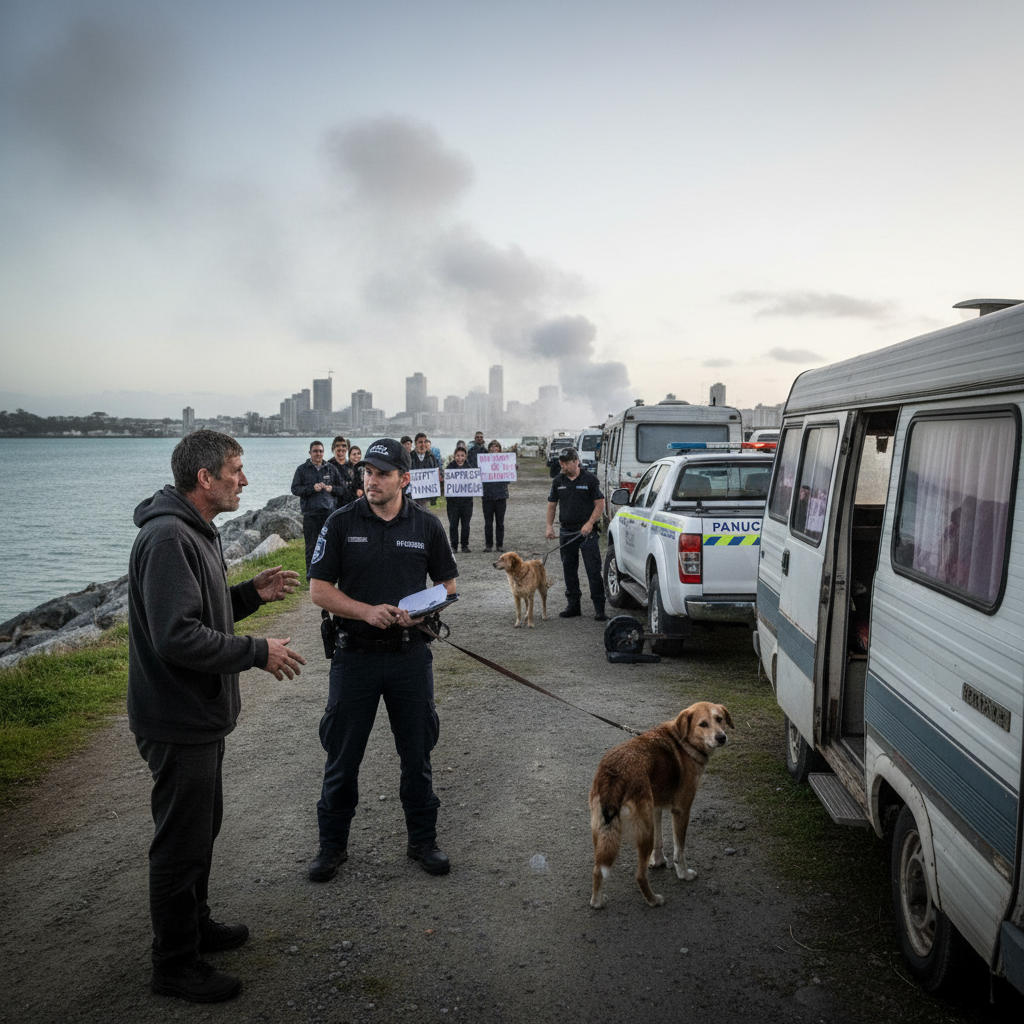
Tauranga City Council staff and police have cleared out a community of people living in vehicles at Sulphur Point, issuing fines and impounding dogs in an operation that has drawn criticism from homeless advocates.
The enforcement action on Monday followed what the council describes as months of engagement and repeated complaints from nearby residents and businesses regarding antisocial behaviour, rubbish and roaming dogs. During the operation, several individuals were issued fines for unregistered vehicles and dogs.
One vehicle-dweller, Samantha Bradley, had her dog, Marley, taken by animal control officers because it was not registered. She also received three new fines, bringing her total debt to approximately $1400, for her unregistered dog and Subaru car. Ms Bradley, who filmed a vehicle being towed from the site, said the loss of her dog has left her feeling unsafe and that she now has nowhere else to go.
The council maintains the action was a necessary response to a long-standing issue and was carried out with care under national legislation. However, advocates for the homeless community argue the operation has only served to increase fear and anxiety, pushing vulnerable people into other suburban areas without addressing the root causes of their situation.
A community on edge
For some time, the public reserve and overflow carpark at Sulphur Point have provided a temporary home for a number of people living in their cars. The area, with its proximity to the Tauranga Marina and boat ramp, is popular with locals and visitors, but its use as an informal camp has created friction.
Samantha Bradley, a former kiwifruit orchard supervisor, said she is trying to work her way out of homelessness but feels trapped by the mounting fines. 'I'm trying to get back to being a legit person. I'm in the process of doing my KiwiSaver application,' she said. She questioned the logic of the enforcement, asking where she could legally go with an unregistered car that she cannot move without breaking the law.
She suggested a compromise that would allow vehicle-dwellers to stay overnight in designated areas, provided they leave by morning. This, she argued, would give people a lawful place to sleep without causing significant disruption.
There's zero places to go.
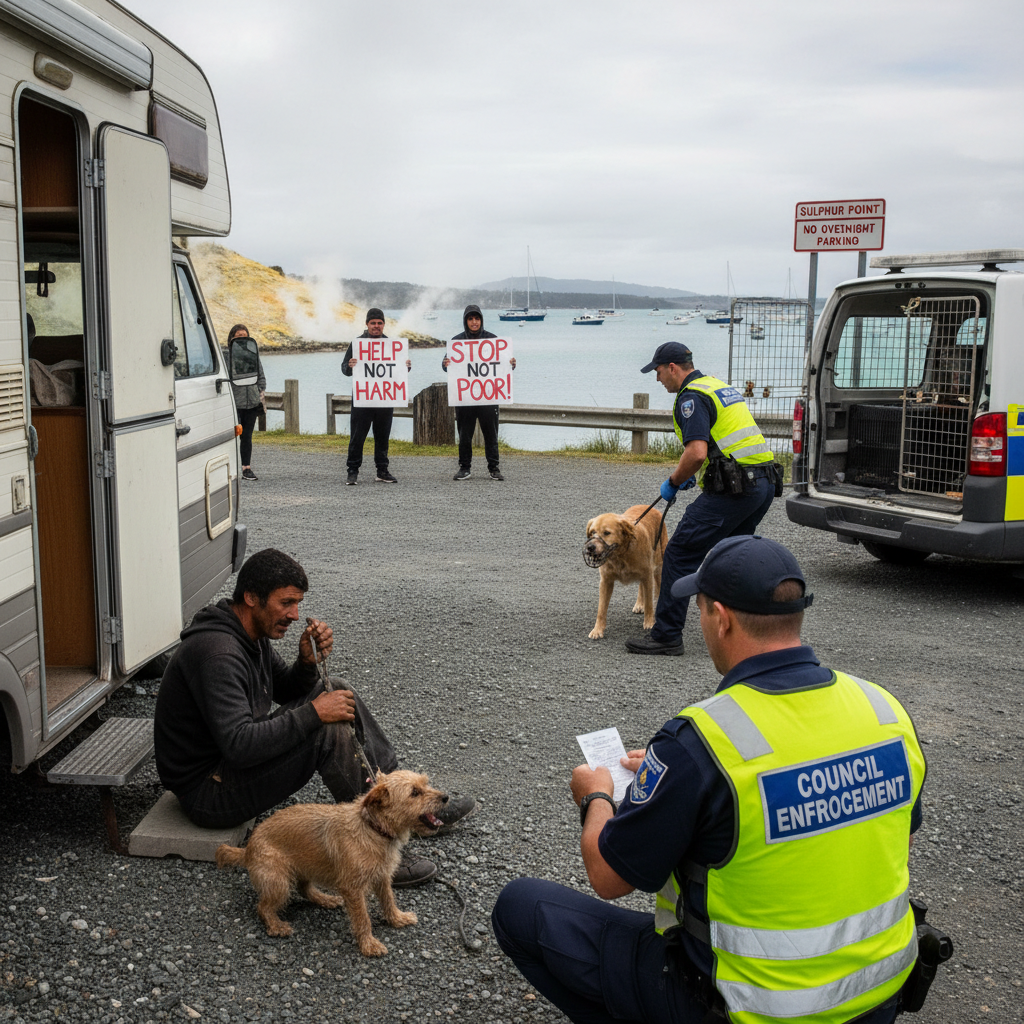
Her sentiment is echoed by Awhina House co-chair Angela Wallace, who works with the homeless community. Ms Wallace said the enforcement has left people feeling unwanted and targeted. ‘They're on edge that their stuff is going to be all packed up and taken away or that they'll be forced to move on,’ she says. ‘They're already in a position where they've got nothing.’
Council cites safety and public complaints
Tauranga City Council officials state the operation was not taken lightly and was the culmination of a lengthy process. Sarah Omundsen, the council’s general manager of regulatory and community services, said some of the individuals had been occupying the reserve for more than a year.
‘Council staff engaged with eight individuals in relation to issues involving vehicles and/or dogs,’ Ms Omundsen said. ‘During these conversations, people were advised that any unregistered dogs could be impounded and any immobile vehicles may be removed.’ She confirmed three dogs were impounded, though one was returned to its owner the same day after its registration was completed.
Te Papa ward councillor Rod Taylor, who has been pushing for action since before Christmas, described the area as becoming ‘very dysfunctional’, citing dog attacks, mental health issues and other serious incidents involving the 15-20 people living there. He said a planned removal was delayed earlier this year following the New Zealand braces for heat and hosts in Bangladesh series and the landslide on Mauao.
The manager of the nearby Tauranga Marina, Greg Prescott, also supported the council's move, stating the marina had been pushing for action over issues of alcohol and drug use, abuse, and mess. ‘We have a lot of foreign folks coming into the marina from all over the world, and it's a really bad look,’ he said.
Displacement and national debate
Homeless advocates argue that such enforcement actions do not solve the problem, but simply move it. Ms Wallace noted that people displaced from Sulphur Point are now appearing in suburban neighbourhoods and community centres, spreading the issue across the city. ‘It would have been great if there had been some support for them rather than some seemingly harsh actions being taken to move them on,’ she says.
She expressed particular concern for Ms Bradley. ‘I feel for her because she's a single woman living in her car. She's quite vulnerable. The only protection she has is her dog; it's been taken from her.’
The local operation comes as the central government considers new legislation granting police "move-on" powers to target behaviour such as rough sleeping and begging. The proposed amendment to the Summary Offences Act has been strongly opposed by advocates, who fear it will further criminalise homelessness. According to the government, the new tools are intended to tackle intimidation and public disorder.
The situation in Tauranga reflects a nationwide challenge, as local councils grapple with housing shortages and the rising cost of living, which contribute to the growing number of people without stable accommodation. Delays in large-scale housing projects, such as the planned 8,000 homes at Te Tumu, add further pressure to the region's housing supply. Similar enforcement actions have taken place elsewhere in the city, with an operation at Arataki Park three weeks ago following resident complaints. Councillor Taylor confirmed several other locations are now on the council's radar.